Maki‑e pens
Mikado
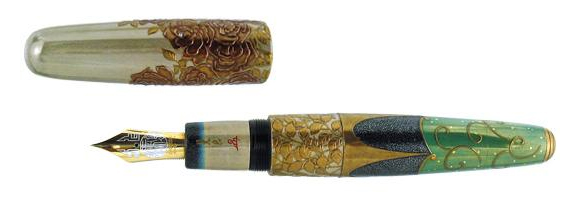
When we only had medium‑size Maki‑e pens, we felt we needed larger pens for more complex Maki-e art; we made Mikado for that purpose, several years ago. This pen uses the Eyedropper system. It is 6‑3/8” long when the cap is closed, and the diameter of the barrel is 13/16” and heavy. The Maki‑e on this pen is very good because of its larger surface area. The nib is size #8, in 18k gold, and available with F, M, B and Stub.
MIKADO › MAYUMI KUMANO (MAYUMI)

Aoinoue, from "The Tale of Genji." Aoinoue, Hikaru Genji's legal wife was ill in bed, and neither her doctors nor the monks could figure out what was wrong with her. A Miko (a maid in the service of a shrine) was consulted and told them that this was an act perpetrated by Hikaru Genji's deceased former lover, Rokujo-no Miyasudokoro; she had come to Aoinoue's bedside and harassed her, trying to take her to the spirit world. The ghost was finally defeated by an ascetic's prayers. All the clothing and flames are made with Taka Maki-e. The design on this section is Hira Maki‑e.


MIKADO › MINORU OOHATA (RAKKAN)
Fugaku 36 Kei and Tokaido 53 Tsugi. Fugaku 36 Kei: Inspiration for this series is the work of artist Hokusai, who drew scenes of Mt. Fuji from 36 different locations. Tokaido (referring to the Tokai Highway) 53 Tsugi: Inspiration for this series is the 53 stations on the highway between Tokyo and Kyoto, by the famous artist Hiroshige and other artists. Believing that Tokaido and Fugaku are two of the best sources for Maki‑e pen designs, I asked Mr. Masanori Omote to create the Grand Trio collection and Mr. Minoru Oohata to create the Mikado collection. There are seven designs in the Tokaido/36Kei series and all use Taka and Togidashi Maki‑e techniques with gold and silver powders forming the main color palette.

The Nihon Bridge (on cap) is located in the center of Edo (Tokyo). This is the first station on the highway towards Kyoto. It was the site of the famous fish market center in Japan; even now, you can see some old shops that are still there from those times. Shinagawa (on barrel) was regarded as a popular rest stop and many tourists stayed overnight there. This town is now the Shinagawa district of Tokyo.

This is a rendering of one of the most famous paintings of 36Kei (on cap), by Hokusai. On the barrel is "Aoyama Enza‑no Matsu" (Pine tree with a dome shape), also by Hokusai. In today's Shibuya district of Tokyo, a temple called "Ryugan Temple" has a famous pine tree in its yard, called Enza‑no Matsu, because the dome and the tree’s branches spread to a diameter of 100 feet.

This image on this cap was inspired by the waves off the coast of Kanagawa. This world‑renowned painting is very often seen on stamps or at famous auction houses worldwide. The barrel has another famous 36Kei, "view of Kajikazawa in Ko‑shu".

Ancient Hodogaya, a station of the Tokaido by Hiroshige (cap), does not look much like its modern‑day counterpart, Katapira‑cho, Yokohama. Kanagawa (barrel), less than 10 miles from Tokyo, was a busy city center in the Meiji era, where consulate offices from America, France, Britain and the Netherlands were located.

The image of the Torii (seen on cap) proves that the bay hasn't changed since olden times. The bay is famous for seashell gathering. Onden was located in the area that is now known as the Harajuku district in Tokyo today, where there is a JR train station but no mill.

People depicted on the cap are appreciating sunsets at Mt. Fuji and the Ryokoku Bridge over the Sumida River from 36Kei. Kanaya, depicted on the barrel, is about 130 miles from Tokyo, located on the Ooi River; it used to be one of the most dangerous crossings for travelers.

Hakone of 36Kei (depicted on cap) is famous for its hot spring, but it was also one of the most difficult routes for people to traverse at that time. On the barrel is the "view from Sekiya‑no Sato at Sumida River".




MIKADO › YUJI OOKADO (YUJI)

One of the mythical Four Gods. The technique employed is Shishiai Togidashi Maki-e with Raden. #8 gold powder and beige Urushi were used to paint the back and the belly of the dragon. #8 gold powder and blue Urushi were used on the body of the dragon.

This is a design from a Noh Play, Dojoji, a story about demons. One day, a new bell was to be hung in the temple and only men were allowed to observe the ritual. A woman asked to enter the temple to see the bell and offered to dance for the men as payment. The woman was finally allowed to dance, but when she danced wildly towards the bell, the bell dropped to the floor and the woman disappeared. The monk of the temple knew this must have been a ghost's doing and recalled the story of a girl called Kiyohime who loved a monk, Anchin. Anchin was afraid of her and tried to hide in the bell of Dojoji; the woman turned into a serpent and wrapped herself around the bell and melted it in her rage. Taka Maki-e technique is used on the serpent, the bell and the Noh mask.

Saigo Takamori (1828‑1877) was very loyal to the Meiji emperor; he was an adviser to the government and strongly supported the Restoration movement. However, he rejected efforts from the country to westernize, while statesmen such as Ito Hirobumi and Okubo Toshimichi opted to educate themselves about western culture in Europe and America. Upon returning to Japan, they opposed Saigo’s decision to invade Korea and to adopt an anti‑westernization stance. Saigo was forced to resign his post and later returned to Kagoshima. He was a patriot with many followers in Kyushu and was eventually swayed by his followers to attack the government. Saigo was defeated in September of 1877 and killed himself in Kyushu. Saigo is regarded as the last Samurai because he died for his principles. His bronze statue, depicted here in the design, still stands in Ueno Park of Tokyo, and to this day he is still admired by many Japanese as a tragic hero.

MIKADO › KOICHIRO OKAZAKI (KOGAKU)




In Japan, flower viewing is very popular and is enjoyed in public places throughout the country. Big cities and rural areas alike have flower viewing festivals with dancing and traditional Japanese music played on the Shamisen (a banjo‑like Japanese string instrument).




MIKADO › MASANORI OMOTE (MASANORI)
At present, there are four major Maki‑e artists working on our Maki‑e. All four were students of Masanori before they became freelancers. Masanori’s most recent work is the Maki‑e on the walls in the main hall of the well‑known Kissho‑in temple in Chita City of the Aichi prefecture. Omote-san has made Maki‑e for us for more than 5 years, and his masterpieces, such as the Tokaido series, have been very well received. His recent works include “Fixed Stars”, “Miyama Enreiso”, “Four Seasons from Ise Monogatari” and of course, “Kirin.” He will appear at the upcoming Washington DC Pen Show with these remarkable works. After more than 50 years of working with Maki‑e, he is now one of the very few artists whose works are deemed “collectible” today.

Kirin in Japanese Kana (syllabary) means “giraffe”, but in Kanji (Chinese characters), it signifies an imaginary animal in Japan. The design is drawn from the popular mythical animal that is widely seen on Kirin beer bottles.
Kirin is derived from “Ki,” for “female” and “rin,” for “male.” The body is of a horse, but its overall look is like a dragon, and the male Kirin has a horn. A Kirin represents justice for all well‑intentioned people and is also considered a good luck omen.
Here is a little known story about the 100 year old Kirin depicted on the beer bottles. The label was originally designed by Rokkaku Shisui, (1867‑1950) a Maki‑e master of Matsuda Gonroku while he was still a starving art student at the Tokyo Fine Art School. He was asked by his friend to create the label to make money. Strangely, the artist never talked about this to anyone nor left any written record about this. The headquarters of Kirin Beer also had no record of who designed the label, but in 1961, Ishikuro Keishichi published a book called “A Tale of Beer” in which he claimed his father‑in‑law, Rokkaku Shisui, was hired by the beer company to design the label and was only paid five yen for his work.
The artist, Masanori Omote‑san used Taka Maki‑e on the Kirins’ bodies and Shishiai Togidashi Maki‑e on the faces.
Platinum powder is used on the tails and the crest of the wave. On the cap, he uses Taka Maki‑e, and Kirigane (rectangular gold foil) and Marugane (round shape gold foil) for the cloud. It is a masterpiece.

The temple at Nagisa. Episode #82
An imperial prince, Koretaka, went hunting with his companions and the party drank for the entire length of their journey. When they reached Nagisa of Koya, they alighted from their horses, picked branches of Sakura and put it in their hair, while composing poems. They continued composing poems as they moved onto Amanogawa.Finally, they returned to the Minase Palace and kept drinking until the moon disappeared.

A small group of companions, feeling helpless in Kyoto, decided to go east in search of a better living. When they arrived at Hatsuhashi, they sat down in the shade of a tree and ate lunch. One of them looked at the beautiful flowers of KAKITSUBATA (irides) andsaid “let’s compose a song!” He started with “KA KI TSU BA TA'' of five lines. Then, someone of them composed:
| KAragoromo | Dress in Chinese design |
| KItsutsunareshini | already accustomed to wear it |
| TSUmashiareba | he left his wife in Kyoto |
| BArubarukinuru | all the way from home |
| TAwoshizoomou | sad to think of the traveling |
It is sad for him to think of his wife, in Chinese dress, left at home, and that he had to travel away from her. Because each man had left his wife at home, they all heard the song and cried, their tears dropping on their meals of rice.

A man split up with his sweetheart, and the woman felt so sad that she sent her lover a song, professing that she was dying to see him. He went to see her one evening, and the woman told him that after just one night of absence, one thousand nights in Autumn would be too short for her to express her words of love. The man loved her even more than ever before.

There was an old man who worked for Prince Koretaka. One day, Koretaka unexpectedly became a priest. The old man walked through the heavy snow and made his way to meet him in his hermitage. Koretaka looked so bored and sad that he talked with him endlessly about the past. The old man returned home that night with tears in his eyes. The prince misconstrued reality as a dream and wondered what he thought of the past.
MIKADO › MASAYUKI HARIA (YUHAKU)


MIKADO › TATSUYA TODO (KOSETSU)